
In Nigerian Elections, Structure Is Not Optional
In Nigeria, elections are rarely won or lost on sentiment alone. The real contest does not happen only at the ballot box. It plays out across communities, party structures, polling units, collation centers, public perception, and sometimes, eventually, in courtrooms.
This is why every serious candidate, political party, support group, or movement must understand one truth early: Popularity is not the same thing as political structure.
A candidate may have public sympathy. Citizens may be frustrated by economic hardship, insecurity, poor infrastructure, unemployment, and years of unfulfilled promises. The people's mood may even favor change. But dissatisfaction does not automatically become votes. Votes do not automatically become victory. And victory, where disputed, cannot be defended without evidence. This is the hard reality of Nigerian elections.
Moving Beyond Empty Political Noise
A serious campaign must go beyond slogans, crowd photos, online trends, and emotional speeches. It is not enough to say the system has failed. A campaign must be able to clearly explain what failed, where it failed, who it affected, and what alternative it is offering. That is the foundation of issue-based politics.
This matters because Nigeria has a large population of citizens who are dissatisfied but unorganized. Many people want better governance, but they do not know where to plug in. Many volunteers are willing to mobilize, monitor, report, and defend votes, but only when they believe the campaign behind the candidate is serious, structured, and competent. Real preparation is not built on last-minute rallies alone. It is built on message, people, training, coordination, data, and visibility.
From Message to Mandate
Every serious political operation must create a clear pipeline:
Clear Message → Engaged Supporters → Trained Volunteers → Ward Coordinators → Polling Unit Presence → Protected Votes
Winning hearts and minds is only the first phase. The real test comes when that support must be converted into organized action across wards, local governments, polling units, and collation centers.
Too many campaigns make dangerous assumptions. They assume large rally crowds mean real grassroots depth. They assume online popularity means polling unit presence. They assume public goodwill will survive election-day pressure without a strong structure behind it.
But on election day, the questions become very practical: Do we know where our supporters are? Do we have verified agents at the polling units? Are our ward coordinators reporting? Can incidents be escalated quickly? Can results be captured immediately? Can leadership see what is happening across the field in real time? Can we prove what happened if the process is disputed?
These are not emotional questions. They are operational questions. And in Nigerian politics, operations matter.
Campaigns Must Prepare for Nigeria’s Realities
Nigeria’s electoral environment is not always a perfect, fair-play environment. A serious campaign must be ready for pressure, confusion, communication breakdowns, compromised field actors, delayed reports, result disputes, collation tension, and legal challenges.
This does not mean campaigns should expect failure. It means they must prepare intelligently. A campaign that truly believes it has the people on its side must also build the capacity to protect that mandate.
If irregularities occur, the campaign must not depend on scattered WhatsApp messages, random voice notes, unverified screenshots, or emotional complaints after the fact. It must have organized evidence. It must have timestamps. It must know which polling unit the report came from. It must know who submitted it. It must be able to separate noise from verified information.
And where necessary, it must be able to provide useful evidence for legal review and post-election accountability. This is where structure becomes more than politics. It becomes protection.
The Role of Data and Infrastructure
Modern elections require decentralized field operations with centralized visibility. Thousands of people may be working across different locations, but leadership must still be able to see, understand, and respond to what is happening.
That is the difference between a traditional campaign and a modern campaign operation. A modern campaign does not only ask, “Are people supporting us?” It also asks, “Can we organize that support, track it, protect it, and prove it?”
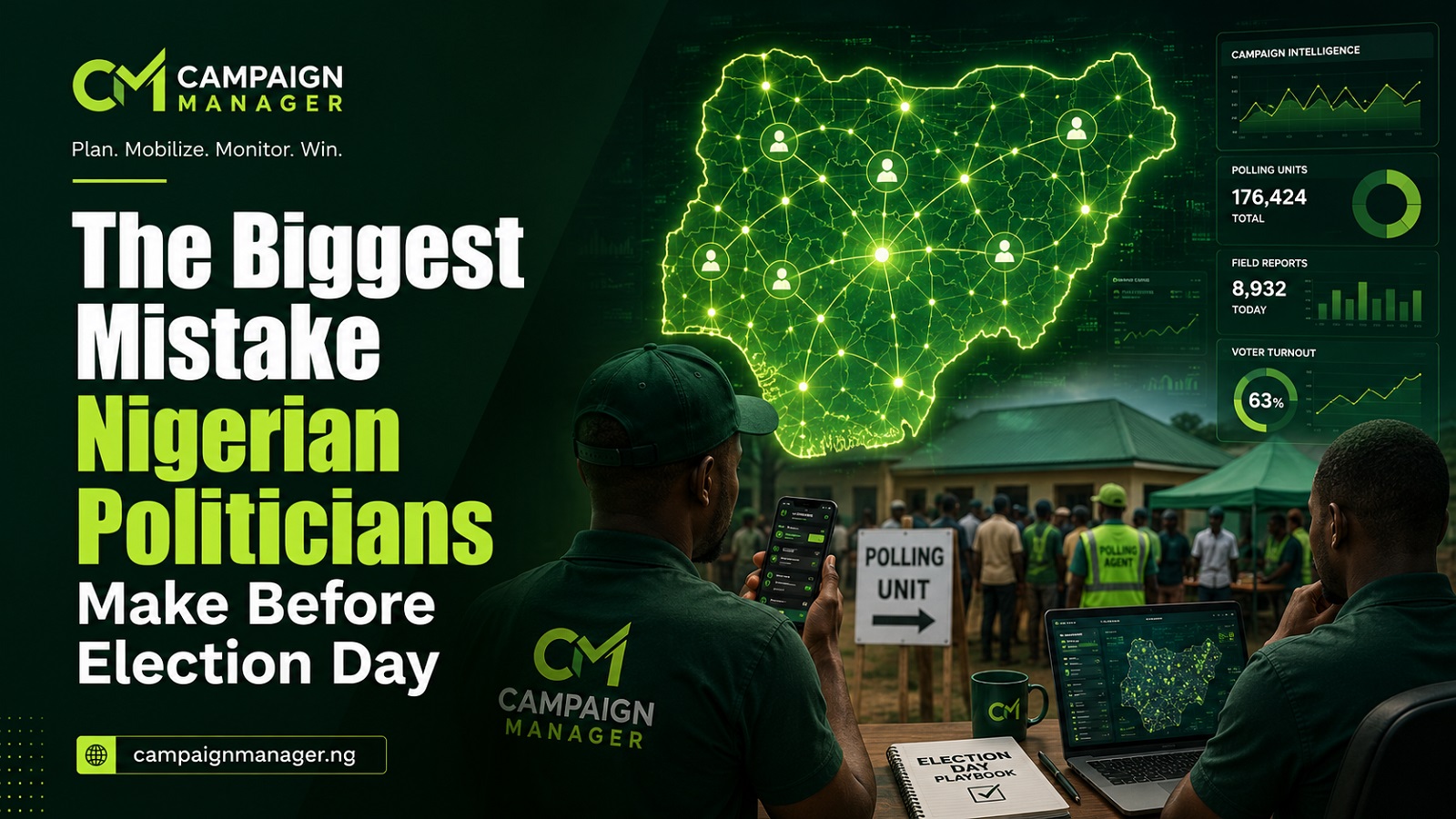
This is the gap that dedicated political infrastructure is designed to fill. Solutions like Campaign Manager are not a replacement for grassroots politics, party structures, field agents, or legal teams. They are the digital command structure that helps all of them work together more effectively.
For a challenger, this kind of structure helps convert organic public enthusiasm into real field organization. For an incumbent, it helps track achievements, strengthen support bases, identify weaknesses early, and defend performance with data. For a political party, it helps transform static membership lists into a living structure that can be used before, during, and after elections.
Visibility Is Power
In modern political campaigning, visibility is command. If a polling unit has no agent, leadership should know. If an incident occurs, it should be reported quickly. If results are counted, they should be captured immediately. If a ward is silent, the system should raise concern. If evidence is needed later, the campaign should not start searching for it after the damage is done. By then, it may already be too late.
The real question after an election is not only, “Did we win?” In many cases, the more important question becomes, "Can we prove what happened?"
That is why serious campaigns must prepare for the full election lifecycle: voter engagement, volunteer coordination, polling unit coverage, incident reporting, result tracking, evidence banking, and post-election accountability.
The future of political campaigning in Nigeria will not belong only to the loudest voices or the biggest rallies. It will belong to the operations that build early, organize deeply, train properly, monitor intelligently, and preserve evidence responsibly.
Having the people on your side is powerful. But it is only the beginning. To win, you must organize them. To protect the mandate, you must see what is happening. And to defend the outcome, you must be able to prove it.
This is the thinking behind Campaign Manager.